
RESEARCH / IMAGE CREDITS / LICENCES
BURIMET
The record behind the drawings: what is documented, what is later interpretation, and where each visual reference comes from.
A NOTE ON METHOD
SOURCE BEFORE STORY
These notes distinguish artifacts from later artworks, and folklore from documented events. Where a portrait’s photographer or licence is unresolved, or an emblem’s origin is unconfirmed, the entry says so.
READ THE COMPLETE KIT SOURCE RECORD ↗PRODUCT RESEARCH
DIELLI
VIEW PRODUCT ↗The sun signs in the brand’s drawings come from Edith Durham’s records in the northern Albanian highlands. Her work documents motifs tattooed on skin and carved into wood in the early twentieth century, not a newly invented symbol.
The oath “Për atë diell” connects that visual material with a living Albanian tradition. The design places the two side by side without assigning one fixed ancient meaning to every sun or cross Durham recorded.
- M. E. Durham, Some Tribal Origins, Laws and Customs of the Balkans (1928) ↗
Smithsonian Libraries catalogue record for Durham’s ethnographic work.
- Durham collection at eHRAF World Cultures ↗
Yale’s record for the 1928 volume and its regional source material.
PRODUCT RESEARCH
HYJNESHA NË FRON
VIEW PRODUCT ↗The terracotta figure was found at Tjerrtorja in Prishtina in 1956 and is kept in the Kosovo Museum. She is 18.5 cm high and belongs to the Vinča cultural sphere of the Neolithic Balkans.
“Goddess” is an archaeological interpretation, not a name written on the object. Published dating ranges differ, so the shirt deliberately uses the find spot, material, height, museum, and discovery year rather than an uncertain date.
IMAGE RIGHTSThe museum photograph used as the visual reference is CC BY-SA 4.0; the ancient object itself is not presented as having a modern copyright owner.
- Museum photograph by Albinfo, 2019 ↗
Wikimedia Commons image record and CC BY-SA 4.0 licence.
- Drita Bruqi Kabashi, Kosova’s Goddess on the Throne ↗
A critical discussion of the object, its interpretation, and its place as a symbol of Prishtina.
PRODUCT RESEARCH
DARDANIA
VIEW PRODUCT ↗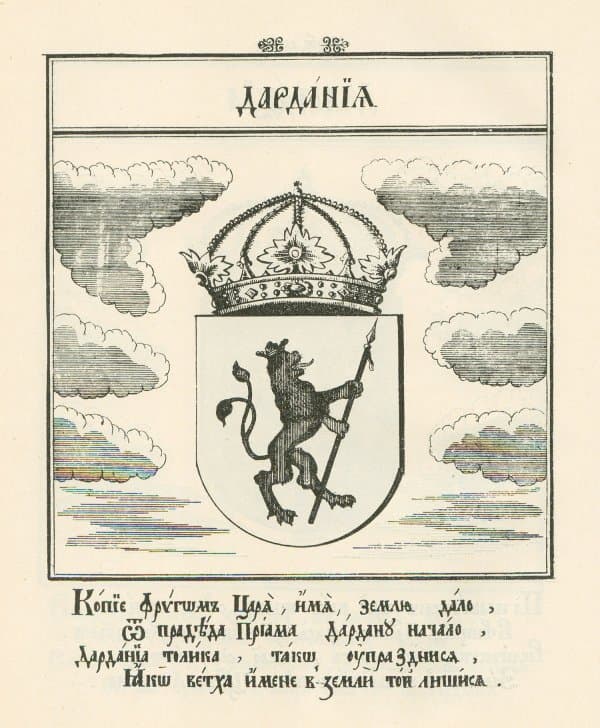
The crowned lion comes from plate 20 of Pavao Ritter Vitezović’s Stemmatographia, printed in 1701. The Latin verse beneath it links Dardanus, Phrygia, and Priam in the learned genealogy presented by that book.
This is an early-modern printed armorial, not a surviving medieval flag. The tee keeps that distinction: its subject is the 1701 image and the story told around it, rather than proof of an uninterrupted ancient state.
- Stemmatographia, 1701 scan ↗
Complete public-domain book scan used for the arms and Latin verse.
- Later engraving of the Dardania arms ↗
Public-domain visual reference shown in the research gallery.
PRODUCT RESEARCH
TEUTA
VIEW PRODUCT ↗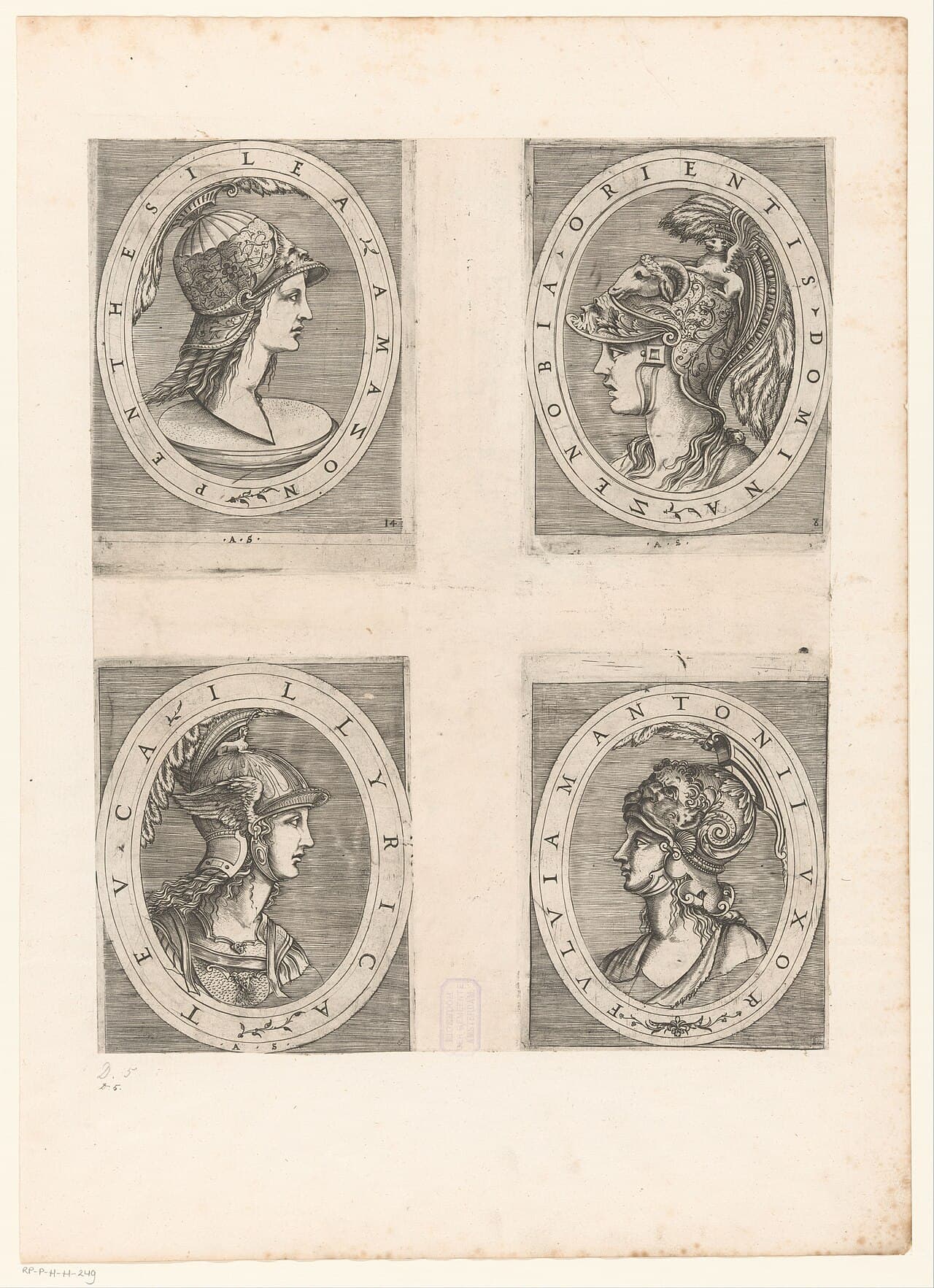
The head labeled TEVCA ILLYRICA belongs to a sheet of four medallions engraved in Italy and published by Antonio Salamanca in Rome between 1510 and 1562. The engraver is unknown; the Rijksmuseum preserves the sheet as RP-P-H-H-249.
No portrait made during Teuta’s lifetime is known. This is a Renaissance artist’s imagined queen, not an archaeological likeness. The ships refer instead to imagery on ancient Illyrian coins, joining two different visual records in one composition.
- Rijksmuseum, Vier vrouwenkoppen ↗
Museum object record, date, publisher, medium, and object number.
- Medallion sheet on Wikimedia Commons ↗
CC0 image of the sixteenth-century print shown in the gallery.
PRODUCT RESEARCH
SKËNDERBEU
VIEW PRODUCT ↗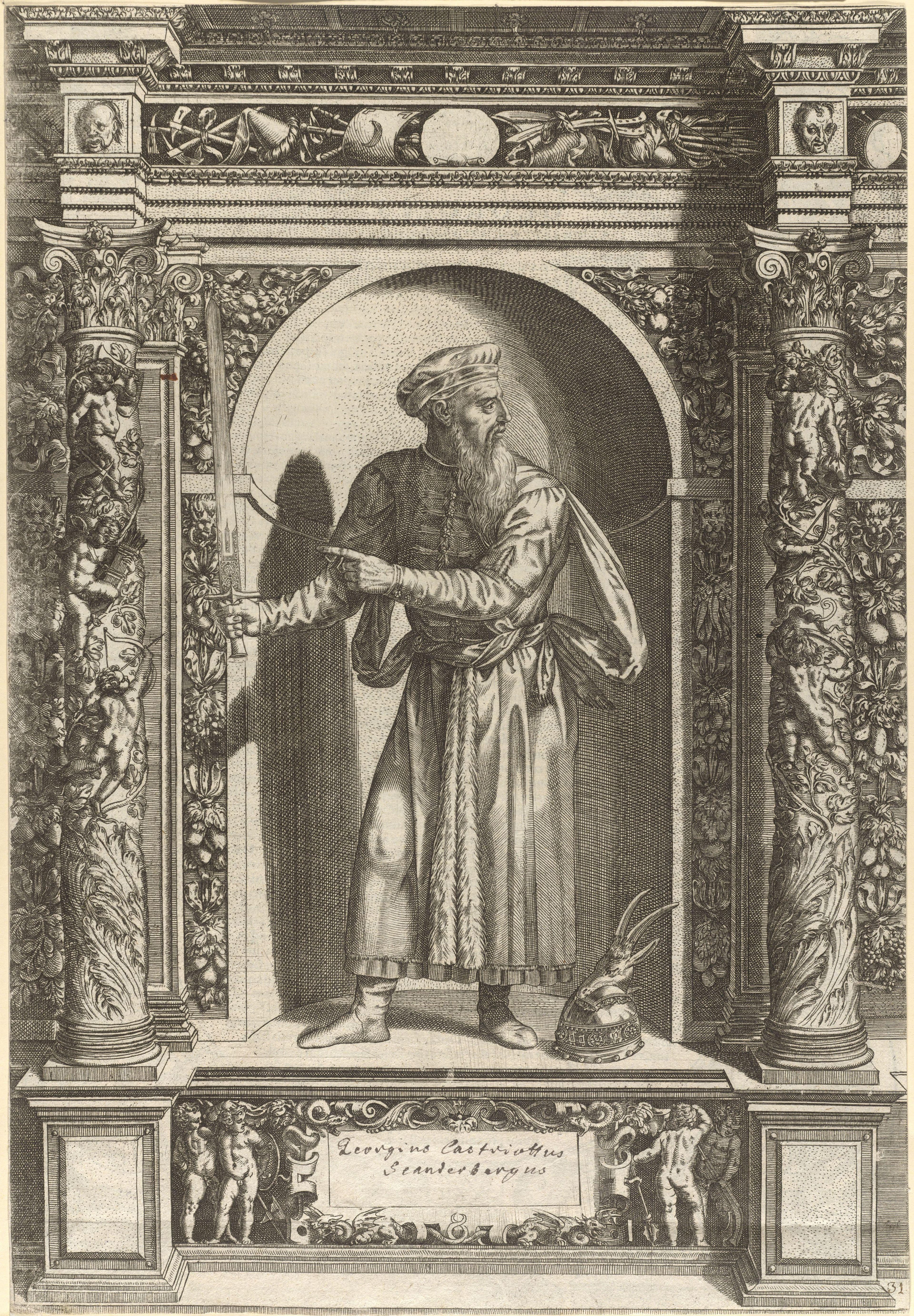
The rider is based on Spiro Xega’s 1931 painting, a modern interpretation of Skanderbeg rather than a likeness from his lifetime. Krujë and the dates anchor the composition in the history associated with his return in 1443.
The quotation on the shirt follows the wording documented in the kit’s source record: Fan Noli’s 1921 history and a 1964 Albanian translation of Marin Barleti. Earlier printed portraits, including the 1601 Fontana–Custos engraving, show how Skanderbeg’s image was already being constructed and celebrated in Europe.
- Spiro Xega, Skënderbeu, 1931 ↗
The public-domain painting used for the rider.
- Fontana and Custos, Skanderbeg portrait, 1601 ↗
Public-domain Austrian National Library engraving shown in the gallery.
- Fan Noli, Historia e Skënderbeut, 1921 ↗
Printed source consulted for the quotation on the shirt.
PRODUCT RESEARCH
PËRKRENARJA
VIEW PRODUCT ↗The Kunsthistorisches Museum describes the helmet as a fragment of an Italian sallet from the late fifteenth century. Its gilt-copper band carries the divided inscription “Inperatorebt,” separated by six flower rosettes, and a goat’s head forms the crest.
Helmet and sword are first documented in the 1593 inventory of Ferdinand II’s collection at Ambras. Their association with Skanderbeg is old, but his ownership is not proven by an uninterrupted record. The long Latin expansion printed on the tee is the traditional reading, not the museum’s explanation of every letter pair.
- Kunsthistorisches Museum, the Skanderbeg helmet and sword ↗
Museum research on the object, inscriptions, inventories, and uncertain earlier provenance.
- Helmet photograph by Jebulon, 2012 ↗
CC0 visual reference used for the engraving; no external photograph is displayed on this page.
PRODUCT RESEARCH
ROZAFA
VIEW PRODUCT ↗Rozafa belongs to a legend of immurement: a mother is built into the wall but continues to nurse her child. It is a story told around the castle, not a documented historical event. The closing verse on the shirt comes from the inscription photographed beside the modern relief.
The castle view has a separate visual history. Edward Lear visited and drew Shkodër in the nineteenth century; his 1851 lithograph supplies the landscape. The mother and child are read from Skënder Kraja’s modern relief in the castle museum, so the two parts of the design have different origins and rights.
IMAGE RIGHTSLear’s lithograph is public domain. Kraja’s relief is a modern copyrighted work; the kit records the owner’s decision to use it as a reference.
- Edward Lear, Skódra, 1851 ↗
Public-domain lithograph used for the castle and its hill.
- Rozafa Castle and the immurement legend ↗
Secondary overview of the legend, the nursing motif, and the castle’s history.
PRODUCT RESEARCH
ZANA
VIEW PRODUCT ↗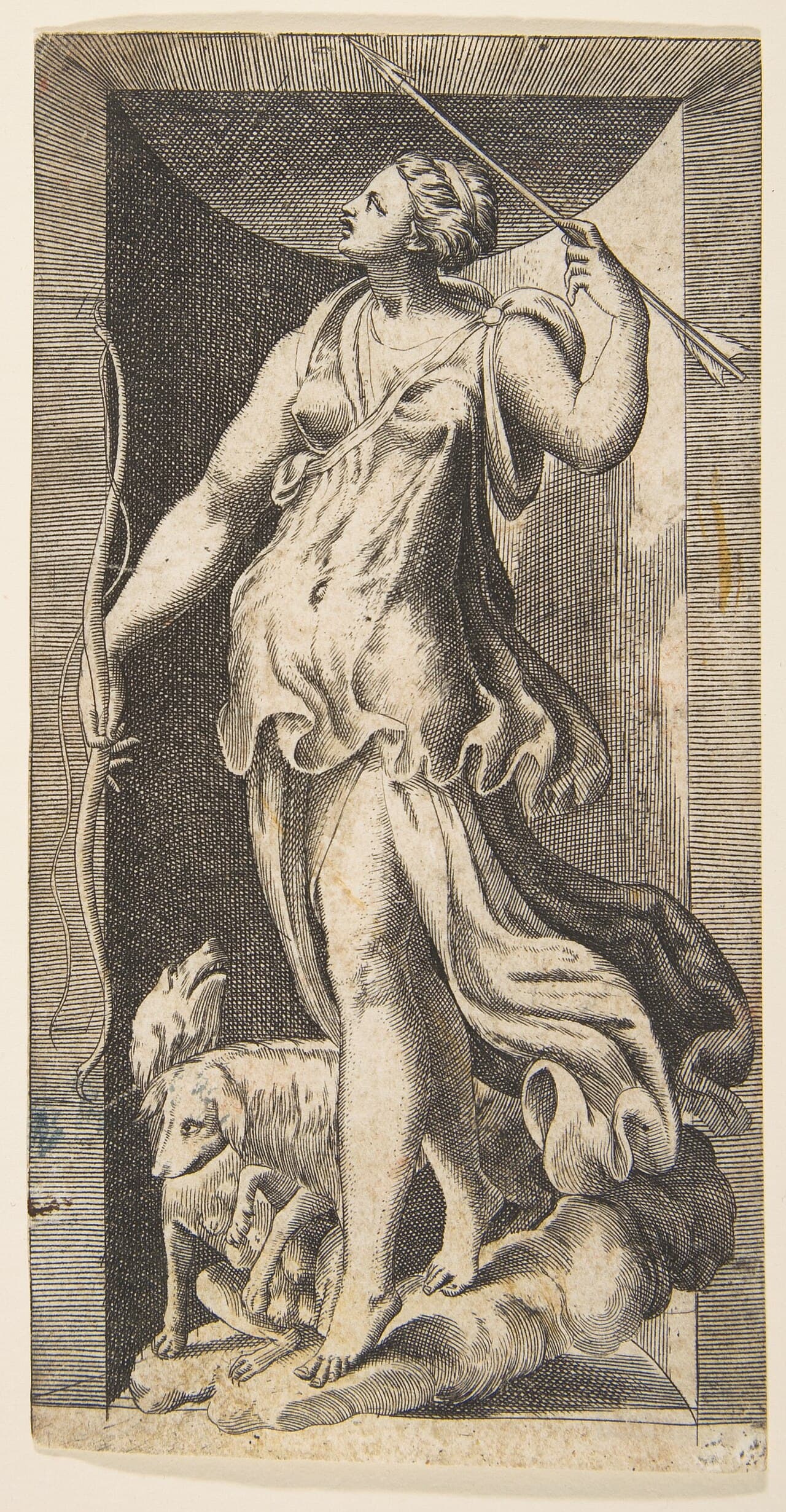
The zana is a figure of Albanian mountain folklore. The sayings “Trim si zana” and “Çdo mal ka zanën e vet” connect courage and place without turning the drawing into an illustration of one canonical story.
The visual model is Giulio Bonasone’s sixteenth-century Diana with bow and hounds, accession number 49.97.295 at the Metropolitan Museum of Art. It was chosen as a visual relative of the zana, not as evidence that the Albanian figure and the Roman goddess are identical.
- Metropolitan Museum, Diana by Giulio Bonasone ↗
Museum object record for the engraving and its accession number.
- Bonasone engraving on Wikimedia Commons ↗
CC0 image shown in the research gallery.
- Zana in Albanian folklore ↗
Secondary overview of the figure and the sayings used on the shirt.
PRODUCT RESEARCH
SHENJAT E MALËSISË
VIEW PRODUCT ↗These are selections from Edith Durham’s drawings of tattoo marks and carved wood in Shala and Theth. The kit’s source record identifies her 1928 tattoo plate and material recorded during her 1908 travels.
Their meaning should not be flattened into a generic “ancient symbol” label. The design preserves Durham’s shapes and her recorded locations, presenting them as documented highland practices from the early twentieth century.
- M. E. Durham, Some Tribal Origins, Laws and Customs of the Balkans ↗
Smithsonian catalogue record for the 1928 publication containing the tattoo material.
- High Albania and its customs in 1908 ↗
Durham’s regional ethnographic material and publication record.
PRODUCT RESEARCH
ZAHIR PAJAZITI
VIEW PRODUCT ↗Zahir Pajaziti was born in the Llap region in 1962 and was killed on 31 January 1997. He is remembered as one of the early commanders of the Kosovo Liberation Army; the design leaves out titles and lets the portrait, the Llap date line, and the stone kulla carry the reference.
The house links the composition to Orllan and to the night scene in the collection. This is a commemorative image assembled from separate references, not a single photograph of Pajaziti outside that house.
IMAGE RIGHTSThe portrait was supplied by the owner; its photographer and rights are unknown. The kulla reference is recorded in the kit as CC BY-SA 3.0.
- Zahir Pajaziti, biographical overview ↗
Secondary reference for his dates and role.
- Prishtina Insight, remembrance of 31 January 1997 ↗
Contemporary reporting on Pajaziti and the memorial anniversary.
PRODUCT RESEARCH
UÇK
VIEW PRODUCT ↗The eighteen names are printed alphabetically in six small lines. They are drawn from people included in the Albanian list of the order “Hero i Kosovës,” with the kit recording the spelling choices and the references consulted for each name.
The oval seal’s origin is not confirmed. The kit explicitly says that no independent copy or source was found for the screenshot from which it was redrawn, so the website does not repeat the unsupported claim that it was the movement’s first logo.
IMAGE RIGHTSThe rifle shapes come from a purchased stock pack. The original pack files are not distributed with the website.
- Urdhri Hero i Kosovës ↗
Albanian-language list used to check the names included in the design.
- Complete source record in the brand kit ↗
The documented name-by-name notes, spelling decisions, stock-pack record, and the unconfirmed-emblem warning.
PRODUCT RESEARCH
ADEM JASHARI
VIEW PRODUCT ↗The dates on the shirt are 28 November 1955 to 7 March 1998, and the place is Prekaz. The portrait is on the chest; the motorbike and oval seal form the separate back composition.
The image is commemorative rather than documentary: two different photographs were combined with an emblem read from a screenshot. The kit records that the seal’s claimed origin was not independently confirmed, and that the photographs have unresolved rights.
IMAGE RIGHTSThe motorbike photograph’s photographer and licence are unknown. The chest portrait comes from a 1998 Kosovarja poster recorded as copyrighted.
- Adem Jashari, biographical overview ↗
Secondary reference for the dates and place used on the shirt.
- Complete source and rights record in the brand kit ↗
Details of the two photographs, the unconfirmed emblem, and the unresolved image rights.
PRODUCT RESEARCH
AGIM RAMADANI
VIEW PRODUCT ↗Agim Ramadani was born in Zhegër in 1963 and was killed at Koshare in April 1999. Biographical accounts also record his poetry and painting; the design draws the risen sun like a painter’s sketch and makes his name, Agim, part of the hour it represents.
The two Gheg lines are read from the inscription on his bust in Zhegër, not invented for the shirt. Their English explanation in the catalog follows that inscription, while the portrait and memorial bust remain separate visual sources.
IMAGE RIGHTSThe portrait was published by Periskopi; its photographer and rights are unknown. The bust inscription reference is recorded as CC BY-SA 3.0.
- Agim Ramadani, Albanian Heritage biographical entry ↗
Biography based on Fjalori enciklopedik i Kosovës, including his artistic work.
- Agim Ramadani, biographical overview ↗
Secondary reference for the dates used in the design.